What Is Post-Tensioning and Why Choose It?
Post-tensioning is an advanced structural technique in which prestressing force is applied to reinforced concrete after casting, increasing load capacity, extending spans and enabling thinner sections. Since 1994, ASZ Grup has built extensive field experience and, since 2012 as a corporate brand, has become one of Turkey's leading post-tensioning solution partners.
Our post-tensioning systems cover bonded and unbonded post-tensioning, stay cable solutions, and anchorage, strand, duct sheathing and grouting products. We deliver end-to-end services from design support and material supply to field execution and supervision.
Post-Tensioning System Components
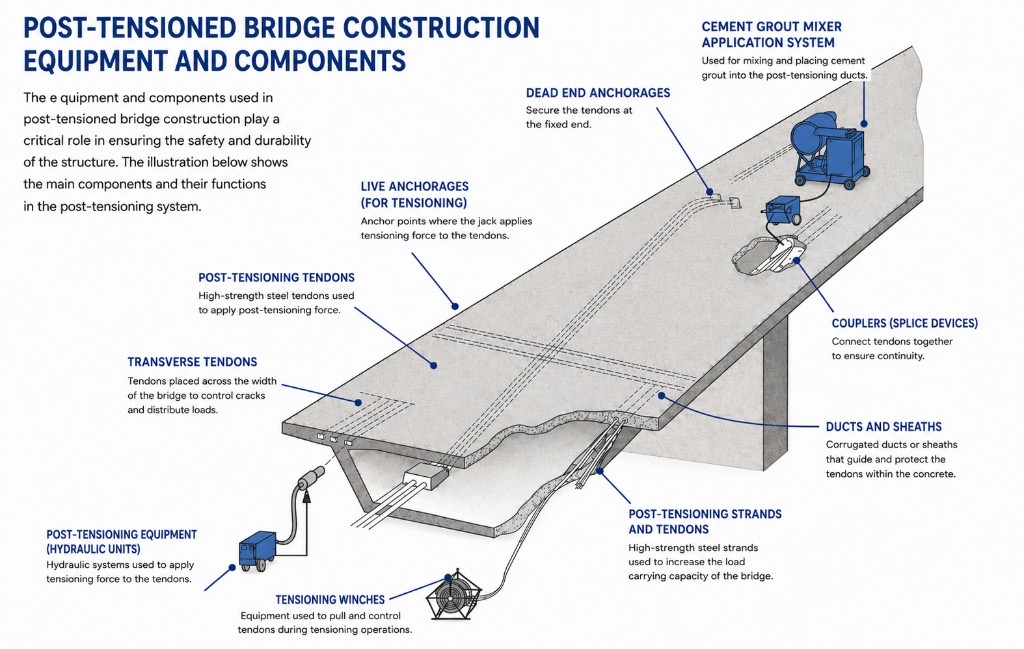
A complete post-tensioning system comprises prestressing strands, anchorage heads, duct or sheath elements, wedge sets, grout material (in bonded systems) and field stressing equipment. ASZ Grup supplies all of these components tailored to project requirements.
Strand & Reinforcement
EN 10138 compliant, low-relaxation post-tensioning strands and prestressing steel.
Anchorage Systems
Active and passive anchor heads with 1–55 strand capacity options.
Duct Manufacturing
Metal duct and HDPE sheathing for bonded and unbonded applications.
Stay Cable
High-performance stay cable systems for cable-stayed bridges.
Application Areas
- Bridges & viaducts — balanced cantilever, incremental launching, precast segment
- Buildings & long spans — slab and beam post-tensioning
- Cylindrical structures — LNG tanks, silos, treatment plants
- Stay cable bridges — long-span cable-supported structures
Post-Tensioning Systems Catalogue
TENSA Cat 2 post-tensioning catalogue: anchorage, strand, accessories and technical specifications.
Frequently Asked Questions
What is the difference between prestressing and post-tensioning?
Prestressing is the general concept of introducing compressive force into concrete. Post-tensioning applies that force after concrete is cast by stressing tendons with hydraulic jacks. It should not be confused with pre-tensioning, where strands are stressed before concrete is placed.
When should bonded vs. unbonded post-tensioning be used?
Bonded systems are preferred for bridges, viaducts and cylindrical structures. Unbonded systems suit building slabs and long-span floor structures. See our bonded and unbonded pages for detailed guidance.
Which standards does ASZ Grup comply with?
Our materials and execution align with EN 10138 (strand), EN 523/524 (duct sheathing), ETA-certified anchorage systems and applicable national structural design codes.
For technical details, catalogues or project-specific quotations, please reach us via our contact page.
Request a Quote